
McKinney, Texas Development: What’s Coming in 2026, 2027 & Beyond
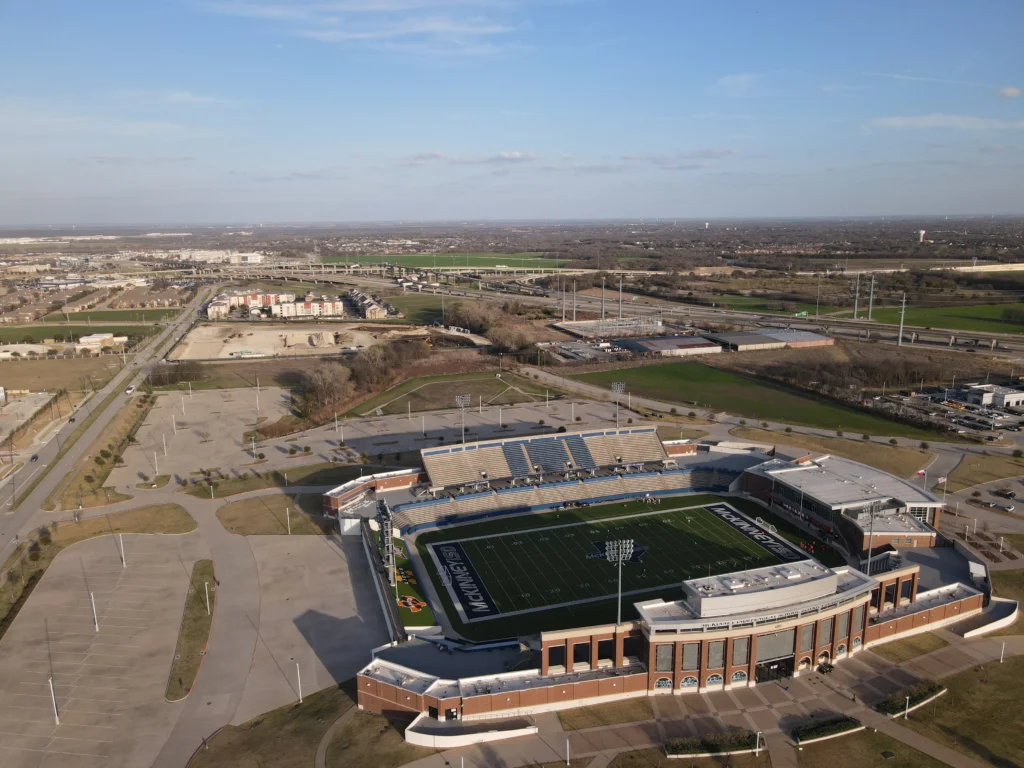
From a 20,000-seat amphitheater and $200 million surf resort to commercial air service, McKinney is entering another major era of growth
McKinney, Texas has spent decades transforming from a small North Texas community into one of the most desirable and fastest-growing cities in the Dallas-Fort Worth region.
The next few years could bring another significant transformation.
Major entertainment destinations are under development. Commercial passenger flights are coming to McKinney National Airport. A $200 million surf and adventure resort is under construction. A 20,000-seat amphitheater is planned along the US-75 and SH-121 corridor. Corporate and advanced-manufacturing investment continues, while roads, parks, trails and public infrastructure are expanding alongside the city’s population.
McKinney’s own population estimate placed the city at 224,043 residents as of January 1, 2025, including approximately 59,000 single-family housing units and nearly 23,000 multifamily units.
That growth is increasingly being matched by investments designed not only to accommodate more residents, but to make McKinney a larger employment, tourism, entertainment and transportation destination within North Texas.
Here’s a look at some of the biggest developments shaping the future of McKinney, Texas through 2026, 2027 and beyond.
VENU Sunset Amphitheater: A 20,000-Seat Entertainment Destination
One of McKinney’s most visible upcoming developments is the VENU Sunset Amphitheater.
Planned for approximately 46 acres at the northeast corner of US-75 and SH-121, the outdoor entertainment venue is expected to accommodate as many as 20,000 guests at full capacity.
The City’s project information currently places completion in summer 2027.
The scale becomes clearer in the project’s site plans.
The November 2024 plan identifies approximately 45.74 acres, seating for 20,000 and 5,106 parking spaces, including structured parking.
The development is projected to represent approximately $300 million in economic investment, support more than 1,300 direct and indirect jobs, and generate more than $3 billion in economic impact during its first decade, according to the City.
What is planned at Sunset Amphitheater?
The venue is expected to feature a canopied seating area with heating and cooling features, premium suites, VIP hospitality areas, concessions, parking garages and other supporting facilities.
A multi-season configuration is planned to accommodate approximately 5,000 guests for smaller events, while the full venue can expand to 20,000 for major concerts. The developer anticipates programming of 70 or more shows annually.
For McKinney, the significance extends beyond concerts.
Thousands of visitors arriving for events can create additional demand for restaurants, hotels, retail, rideshare services and entertainment, particularly around the southern US-75/SH-121 gateway into the city.
Cannon Beach McKinney: A $200 Million Surf & Adventure Resort
A few miles away, another destination-scale development is taking shape.
Cannon Beach Surf & Adventure Park is under construction on approximately 35 acres at the northeast corner of Stacy Road and SH-121.
The development broke ground in December 2025, and its first phase is currently projected to open in mid-2027.
At approximately $200 million, Cannon Beach is designed to be considerably more than a water park.
Its centerpiece will be a massive surf lagoon capable of generating surfable waves in landlocked North Texas.
Plans surrounding the water attraction include a full-service resort hotel, lazy river, mineral hot springs, dining, entertainment, indoor recreation, fitness facilities, a skate park, movie theater and bowling alley.
The development has also contemplated office and business space, creating a mixed-use destination rather than a stand-alone attraction.
The rendering supplied with the project illustrates that concept particularly well: instead of a traditional water park surrounded primarily by slides, the lagoon becomes the center of a larger resort-style environment with hospitality, recreation and gathering spaces surrounding the water.
Cannon Beach could become a major McKinney tourism driver
Current economic-development projections estimate:
- $200 million investment
- 700+ jobs
- Approximately 400,000 annual visitors
- More than $2 billion in projected economic impact over 20 years
Combined with Sunset Amphitheater, Cannon Beach could significantly change McKinney’s position within North Texas.
Instead of residents routinely leaving Collin County for major entertainment destinations, McKinney is investing in attractions capable of bringing visitors into the city.
McKinney National Airport: Commercial Passenger Flights Arrive in 2026
Arguably the most consequential development isn’t an entertainment project at all.
It’s McKinney National Airport.
McKinney National Airport has historically focused primarily on general and corporate aviation.
That changes in November 2026, when the airport is scheduled to open its new commercial passenger terminal and begin scheduled passenger service.
The new terminal is approximately 46,000 square feet and is being designed initially with:
- Four passenger gates, expandable to six
- Centralized food and beverage concessions
- Passenger hold rooms
- Approximately 980 public parking spaces
- On-site rental cars
- Ground transportation services
Avelo Airlines has been announced as the airport’s first commercial carrier.
For travelers, the airport will use DTX as its commercial IATA airport code, while TKI will continue to be associated with the airport’s general aviation operations.
That’s a major change for McKinney.
Instead of traveling south to DFW International Airport or Dallas Love Field for every commercial flight, residents of McKinney and surrounding North Texas communities will have another option much closer to home.
The Airport Expansion Is Bigger Than the Passenger Terminal
Commercial flights are only one part of the investment occurring at McKinney National Airport.
The City is also extending Runway 18/36 by approximately 500 feet at its north end, with completion currently anticipated in October 2026. Taxiway C and the FM 546 roundabout are also under construction, while another phase of Taxiway A rehabilitation is scheduled to extend into 2027.
McKinney’s long-range comprehensive plan specifically identifies maintaining and enhancing airport infrastructure to meet current and future customer demand as a priority.
That matters economically because an airport is more than a transportation facility.
Corporate aviation, commercial passenger service, hangars, logistics, aerospace-related businesses and surrounding commercial development can all contribute to the larger Business and Aviation District envisioned on McKinney’s east side.
McKinney Is Also Attracting Major Technology Investment
Entertainment and tourism may generate the most attention, but McKinney’s economic-development story increasingly includes technology and advanced manufacturing.
In July 2026, McKinney announced a major investment from LITEON representing approximately $919 million and more than 600 new jobs.
The project reinforces McKinney’s position within a much larger technology corridor taking shape across North Texas.
McKinney already has a substantial corporate and manufacturing base, while neighboring communities including Sherman, Richardson, Plano, Allen and Frisco continue attracting semiconductor, technology, defense and advanced-manufacturing investment.
The combination of employment growth + transportation + housing + entertainment is important.
McKinney isn’t simply adding rooftops to accommodate population growth. The city is also building the employment and lifestyle infrastructure needed to function as a more complete economic center.
Historic Downtown McKinney Continues to Evolve
Not all of McKinney’s growth is occurring along new highway corridors.
Historic Downtown McKinney remains one of the city’s defining assets.
The downtown district has served as the community’s center since 1848 and today combines restaurants, locally owned businesses, entertainment, cultural attractions and community events while retaining much of its historic character.
That established downtown becomes increasingly valuable as the rest of the city grows.
While new developments like Cannon Beach and Sunset Amphitheater create large-scale entertainment destinations, Historic Downtown McKinney offers something completely different: an established walkable district with local restaurants, shopping, arts and cultural events.
The McKinney Performing Arts Center is also undergoing renovation, with construction underway in 2026 and completion estimated for fall 2026.
The ability to grow without abandoning its historic core may ultimately be one of McKinney’s strongest competitive advantages.
Parks, Trails & Open Space Are Part of McKinney’s Growth Strategy
Growth isn’t limited to buildings and roads.
McKinney’s Trails Master Plan specifically calls for expanding a connected citywide trail network and coordinating trails with parks, natural areas, recreation centers and future development.
The broader parks planning effort identifies additional parks, parkland, trails and recreational facilities as priorities as development continues.
That planning becomes increasingly important as vacant land develops.
McKinney’s comprehensive plan specifically recommends acquiring land and right-of-way for parks, open space and trails ahead of development pressure, rather than attempting to retrofit those amenities after surrounding land has already been developed.
For homeowners, those investments can be just as meaningful to everyday quality of life as headline projects like an amphitheater or airport.
Roads and Transportation Will Have to Grow With McKinney
Major destination projects also create transportation challenges.
Sunset Amphitheater alone is designed for up to 20,000 attendees and more than 5,000 parking spaces. The City is already planning intersection and turn-lane capacity improvements surrounding the venue.
The larger transportation picture includes continued road expansion throughout McKinney and the major US-380 bypass project, which will eventually reshape east-west travel through the northern portion of Collin County.
McKinney’s Capital Improvements Program represents billions of dollars in current and planned infrastructure investment across streets, utilities, public facilities, parks, airport improvements and public safety.
These investments are important because McKinney’s next stage of growth isn’t occurring in one isolated part of town.
Development is occurring around SH-121, US-75, US-380, the airport, Historic Downtown, and the city’s northern and eastern growth areas.
McKinney’s Population Growth Explains the Scale of Investment
McKinney’s transformation becomes even clearer when looking at population.
The City’s January 2025 estimate was 224,043 residents.
The population chart included with that report shows the remarkable trajectory: McKinney grew from roughly 54,000 residents in 2000 to more than 224,000 by 2025.
In other words, the city’s population more than quadrupled in roughly 25 years.
And McKinney is planning for additional growth.
The ONE McKinney 2040 Comprehensive Plan is explicitly designed around long-range development patterns, economic diversification, mobility, public investment and maintaining McKinney as a place where people can live, work, play and visit through 2040 and beyond.
The developments now underway are beginning to make that vision much more tangible.
2026–2027 Could Be Transformational for McKinney
Consider what is scheduled to happen within a relatively short period.
2026: McKinney National Airport’s commercial passenger terminal is scheduled to open, commercial flights begin, airport runway and taxiway improvements continue, and other public and private projects advance.
2027: Cannon Beach’s first phase is projected to open, while Sunset Amphitheater is currently targeting summer completion.
And beyond 2027, continued residential, commercial, corporate and infrastructure development will keep reshaping the city.
What’s particularly notable is the variety of investment.
McKinney isn’t betting everything on one industry or one type of development.
It’s simultaneously investing in:
Transportation. Entertainment. Tourism. Corporate development. Advanced manufacturing. Recreation. Parks and trails. Infrastructure. Historic Downtown. Residential growth.
That creates a much broader story than simply another fast-growing Dallas suburb.
What Does McKinney’s Growth Mean for Real Estate?
For homeowners, buyers, sellers and investors, these projects are worth following—but their effect on McKinney real estate will vary substantially by location.
Commercial passenger service may create new opportunities around the airport and eastern McKinney.
Sunset Amphitheater could increase activity around the US-75/SH-121 corridor.
Cannon Beach strengthens the Stacy Road and SH-121 area as an entertainment and hospitality destination.
Road projects may improve access to previously less-connected portions of the city.
And continued corporate investment can support long-term housing demand.
But proximity to development isn’t universally positive.
Traffic, noise, changing land uses and future construction can affect individual properties differently. Buyers considering a home or investment property should understand not just what exists today, but what is planned around it tomorrow.
That’s increasingly important in a city developing as quickly as McKinney.
The Next Chapter for McKinney, Texas
McKinney has already undergone an extraordinary transformation.
What comes next may be less about simply becoming bigger and more about becoming a more complete destination.
A resident could soon live in McKinney, work for a major technology employer, fly commercially out of McKinney National Airport, attend a major concert at a 20,000-seat amphitheater, spend a weekend surfing at Cannon Beach, bike along an expanding trail system and have dinner in a downtown district that dates back to the 1800s.
Those are very different investments, but together they tell the same story:
McKinney’s next phase of growth is already underway.
And 2026 and 2027 could be two of the most consequential years yet.